You don’t want to fix your schedule.
You want to stop paying for your success with your sanity.
Your Next Step is a self-directed audio course that walks health professionals through figuring out their next move, step by step, without throwing away what you've built.
You've spent years building this career.
But the role you're in right now doesn't feel right.
You're still showing up. Still doing good work. You're probably one of the best on your team. The person others come to for advice, the one who mentors the juniors, the one whose judgment people trust.
But something has shifted. The work that used to feel meaningful is running on autopilot. You're not unhappy exactly. You're underwhelmed. And you feel quietly guilty about that, because you know how much you've invested to get here.
When you look five years ahead and try to picture more of the same, something in you says no. Not dramatically. Just no.
"The role is fine. I'm good at it. But is this as good as it gets? Because if it is, I don't know how to feel about that."
"I knew I needed out. I got out. But I still don't know what I'm actually moving toward. That's its own kind of stuck."
Either way, you haven't told many people. Maybe you told one person and they said "but you're so good at what you do." And that shut the conversation down. So you carry it privately. You've probably googled "career change for health professionals" at some point. Maybe late at night when you weren't going to tell anyone.
You're not looking for someone to tell you what to do. You're looking for a process rigorous enough to trust with a decision this big. That's what this is.
You make complex decisions for other people every day.
So why is this one so hard to figure out on your own?
You've probably done a personality quiz or two. Myers-Briggs. StrengthsFinder. They told you things you already knew about yourself and didn't help you make a decision.
You've read the career change articles. Most of them were written for people in corporate roles, not someone who has spent a decade building real expertise in health. A sector that has its own language, its own culture, and its own very specific idea of what a serious career looks like.
You've thought about more study. Another qualification. Something that feels like forward movement.
"If I just get one more credential, it'll open the door to something new."
"I should be able to figure this out. I'm a smart person. I make hard decisions at work every day."
"Maybe I just need more time to think about it."
That last one is the most honest. Because career decisions are genuinely different from the decisions you make at work. In your professional role you have frameworks, colleagues to consult, a body of evidence to draw on. You know how to make a good decision when the structure exists to support it.
Career decisions at this stage don't come with that structure. The options aren't laid out in front of you. The criteria aren't obvious. And the stakes feel personal in a way that makes it hard to think clearly. That's not a failure of intelligence. It's a failure of process.
Your Next Step gives you the process.
When you have the right process,
the decision stops feeling impossible.
You stop running the same argument on repeat.
You stop collecting more information as a way of avoiding the decision.
You stop waiting for certainty that was never going to arrive.
Instead you end up with a clear picture of what you've built and what it's actually worth. A compass built from what you genuinely value. A real list of possibilities tested against criteria you set yourself.
A direction. Not just a vague intention.
And the question shifts. It stops being "is this as good as it gets." It becomes "what is the most honest thing I can do with everything I've already got."
That's a completely different question. And it has an answer.
Your Next Step — $249 · One-time · Lifetime access
Get instant accessPrivate podcast · 33 episodes · Workbook included
This isn't about which profession you're in.
This is about the considered way you need to approach decisions at this stage of your career.
You chose this career for real reasons. You've stayed in it for real reasons.
But somewhere along the way something shifted. Maybe the work no longer stretches you. Maybe what you want from your professional life has quietly changed. Maybe you've grown into a clearer sense of what matters to you and the role you're in just doesn't reflect that anymore.
The source of the mismatch doesn't matter as much as the fact that it's there.
You might feel like you should be able to work this out on your own. You're capable. You make hard decisions all the time. But a smart person without a structure is still just thinking in circles.
That's not a capability problem. That's a process problem.
And if you're telling yourself now isn't the right time, it probably won't feel like the right time in six months either. What will be different is another six months of the same internal argument. The same ratio of thinking to action. The same feeling on a Sunday night.
The only thing that changes when you keep waiting is how long you've been waiting.
Five steps. Built for
exactly where you are.
Clear the ground
You identify what's actually been keeping you stuck. Not the surface version. The real version.
The sunk cost thinking. The inherited rules about what a serious career is supposed to look like. The fear you've been treating as a reason to wait.
Know where you are
You build an honest picture of what you've actually got. Not your job title. Not your CV.
Your expertise across four dimensions. What you've built that you're not currently using. What you genuinely value when it's under real pressure.
Build your compass
You create a specific set of criteria for what any good next move needs to look like. For you. At this point in your career.
Not a wishlist. A filter. Something you can actually hold options up against.
Explore your possibilities
You look at what's actually available beyond the bubble you've been working inside.
You brainstorm real possibilities. You figure out what kind of move makes sense. And you test it against the compass before you commit to anything.
Take your next step
You turn the direction into a plan. Real actions, in the right order, with the obstacles named before they arrive.
You finish with something you can actually use. Not just clarity. Movement.
Hi, I'm Ruth.
PhD in decision-making · Masters in Health Professional Education · Dietitian · Founder, Career Cliniq · Host, Evolving in Healthcare
12 years as a clinical dietitian, mentoring, educating and developing others. A PhD in decision-making. Conversations with over 100 health professionals from around the world about their health careers.
I know this challenge from the inside.
I also lived it. I am more than my job. But I needed my next career move to actually account for that. The pressure to have it all was real. What I needed was a process to figure out what my all even was.
I didn't find that course. So I built it.
Something that took me years can now take you a few weeks.

I had all the qualifications but wasn't sure whether to take the leap and leave my established career behind. Working through the Your Next Step process gave me exactly what I needed. I gained such clear insight into my decision that I applied for the role and now have an interview scheduled. If you're on the fence about a major career move, this is exactly what you need.
It's so nice and reassuring and relieving just to be understood. To feel supported by someone who has walked this path. The constant context switching, going from toddler mum to a professional trying to make some kind of impact after 15 years of a strong clinical identity, is a lot. This course has helped me a lot.
Everything inside
Your Next Step.
- ✓33 private podcast episodes10 min max each. Playable from your mobile or desktop. Listen on your commute, your walk, whenever you have headspace.
- ✓A workbookOne structured workbook that runs alongside the audio. This is where the clarity actually happens.
- ✓The Stuck to Alignment Framework™A five step process that walks you from where you are to a clear direction. Built specifically for health professionals navigating considered career decisions.
- ✓Your Career CompassA reusable tool you build across the course and keep forever. Print it out. Put it on the wall. Use it to filter every career yes and no from here on.
- ✓Lifetime accessNo expiry. Go at your own pace. Come back to specific episodes whenever you need them.
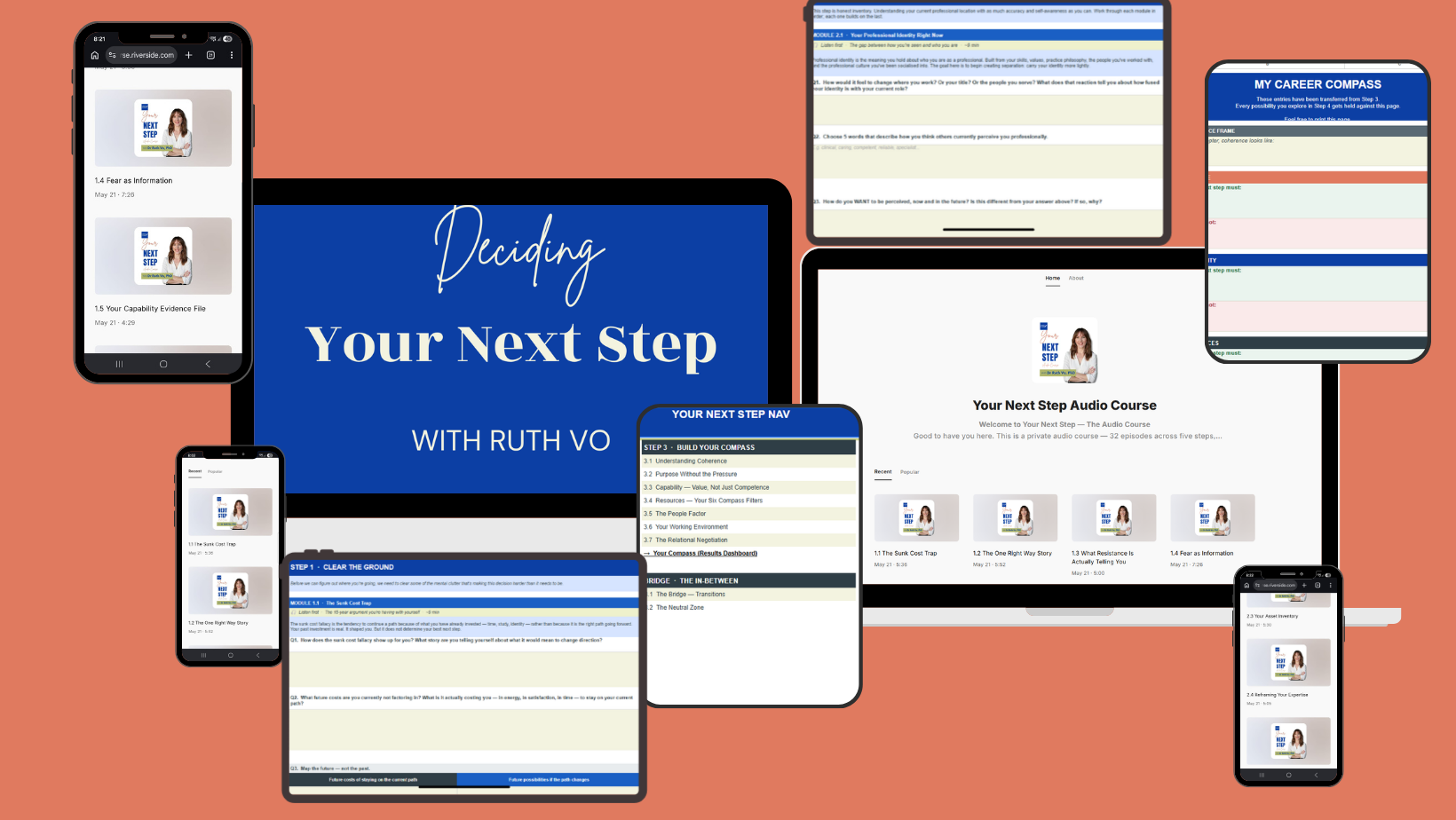
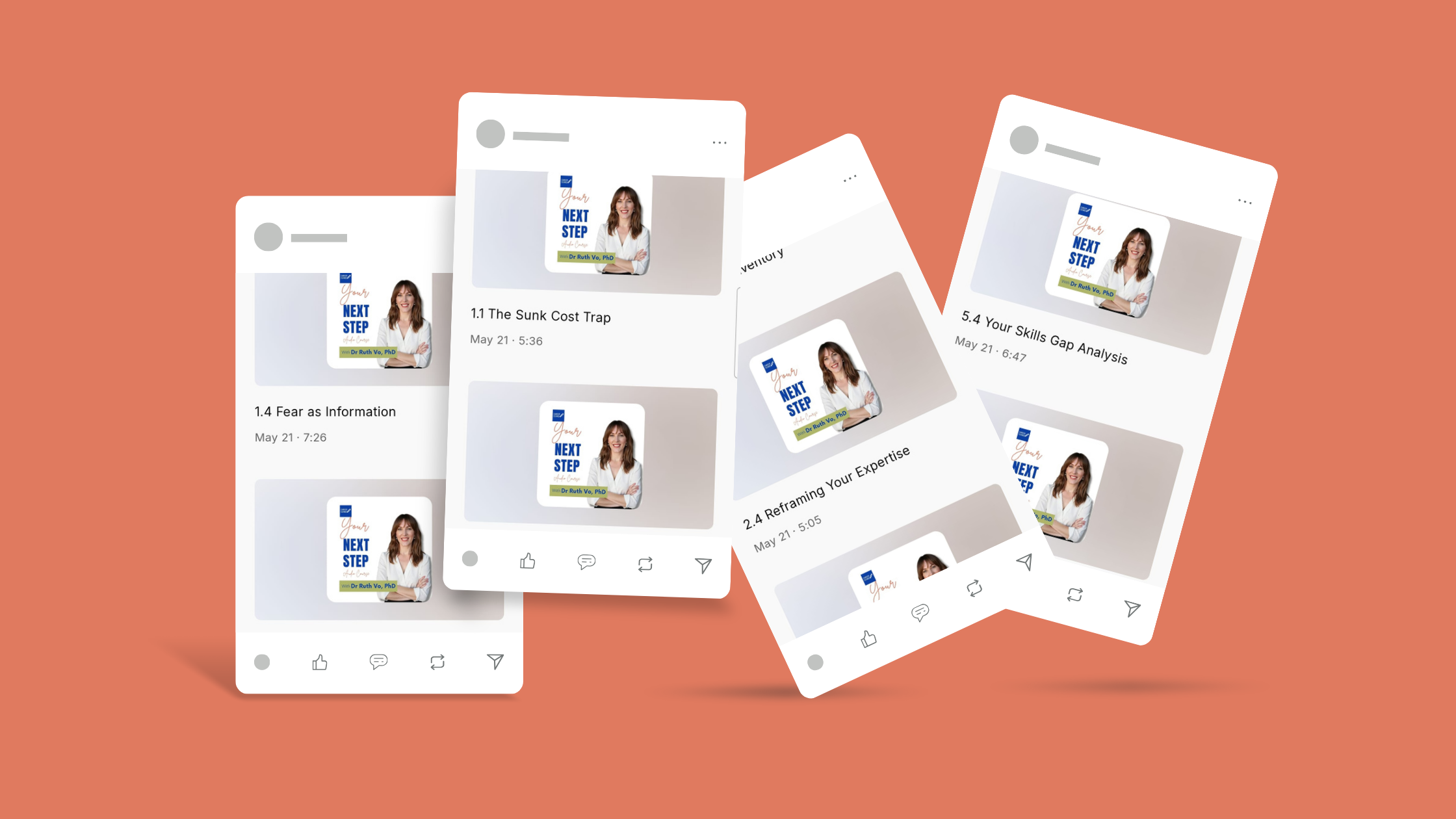
It's a coach in your pocket. Some people will work through every workbook activity. Others will listen and reflect, letting the questions do their work quietly.
Both are valid. Both produce something real.
The audio guides your thinking. The workbook makes it yours. You decide how deep you go.
You don't need a new career.
Or a dramatic leap. Or to have it all figured out before you start.
You need a process that takes the question seriously. One built around you, not your profession's idea of who you should be, so you can finally move from thinking about it to actually doing something with it.
By the time you finish you will have more than clarity. You will have a direction, a compass, and a plan.
Decide Your Next Step
One-time payment · Lifetime access $249
Get instant access (Includes 33 private episodes + the full digital reflection workbook)You will figure this out.
I want to be honest with you. You don't actually need this course. You are capable, experienced, and you will work through this question one way or another.
People navigate career transitions without structured support all the time. It just tends to take longer. And it tends to cost more in the meantime. More energy spent going in circles. More decisions made from exhaustion rather than clarity. More months of the same internal argument that could have been weeks.
But here's what I know from my own experience and from every conversation I've had with a health professional standing where you're standing now.
The question you're carrying deserves a proper answer. Not a quiz. Not a pivot promise. A real process, built for someone exactly like you, that takes the decision as seriously as you do.
That's what this is. I'd love to see you inside.